


Planning to stitch a new saree blouse but unsure how much fabric to buy? Whether you want a simple cotton blouse, a stylish sleeveless design, a traditional silk blouse, or a beautiful full-sleeve designer blouse, choosing the right fabric quantity is essential.
Buying too little fabric can limit your design options, while buying too much can increase your expenses unnecessarily.
For most regular saree blouses, approximately 0.80 to 1 metre of fabric is sufficient. However, blouses with elbow-length sleeves, full sleeves, larger sizes, or elaborate designer patterns may require 1.25 to 1.5 metres or more.
The exact quantity depends on your blouse size, sleeve length, fabric width, and chosen design.
In this guide, we’ll explain how many metres of fabric you need for different blouse sizes and styles, along with easy-to-follow measurement charts, practical stitching tips, and answers to commonly asked questions.
1. How Much Fabric Is Required for a Blouse?
Quick fabric requirement guide
Sleeveless blouse
0.70–0.90 m
Short sleeve blouse
0.80–1.00 m
Elbow sleeve blouse
1.00–1.25 m
Full sleeve blouse
1.25–1.50 m
Approximate outer-fabric requirements for a regular adult blouse in about 44-inch-wide fabric, generally sizes 32–40. Lining is additional.
A blouse made with short sleeves typically needs less fabric than one with full sleeves. Similarly, a basic blouse may use less material than a puff-sleeve, peplum, or heavily structured designer blouse.
For everyday planning, 1 metre of 44-inch-wide fabric is a convenient starting point for a regular short-sleeve blouse, provided the size and cutting layout allow it.
2. Blouse Fabric Requirement Chart by Size (32–44)
The size of your blouse plays an important role in determining how much fabric you need. Larger bust measurements may require wider front and back panels, leaving less room for sleeves and other pattern pieces.
Use this size-wise fabric chart before purchasing material.
| Blouse size (bust) | Short sleeves | Elbow sleeves | Full sleeves |
|---|---|---|---|
| 32 inches | 0.80–0.90 m | 1.00–1.10 m | 1.25–1.40 m |
| 34 inches | 0.80–0.90 m | 1.00–1.15 m | 1.25–1.40 m |
| 36 inches | 0.80–1.00 m | 1.00–1.20 m | 1.25–1.50 m |
| 38 inches | 0.90–1.00 m | 1.00–1.20 m | 1.30–1.50 m |
| 40 inches | 1.00–1.15 m | 1.20–1.35 m | 1.40–1.60 m |
| 42 inches | 1.00–1.20 m | 1.20–1.40 m | 1.50–1.70 m |
| 44 inches | 1.10–1.30 m | 1.35–1.50 m | 1.50–1.80 m |
These are approximate shopping allowances for standard-length blouses using fabric about 44 inches wide, synthesized from published tailoring guides. They are not guaranteed cutting requirements. Sleeve fullness, blouse length, lining, print matching, and individual body measurements can change the quantity.
Helpful Tip: If you are buying expensive silk, Banarasi brocade, or embroidered fabric, confirm the cutting layout with your tailor before purchasing. This is especially important for sizes 42 and above and full-sleeve designs.

3. How Much Fabric Is Needed for Different Sleeve Styles?
Sleeve length is one of the biggest factors affecting blouse fabric requirements. Let’s explore how much cloth you may need for different sleeve designs.

Sleeveless Blouse – 0.70 to 0.90 Metres
Sleeveless blouses are a stylish and comfortable choice for summer, casual outings, and contemporary saree looks.
Because they don’t require separate sleeves, they generally use less fabric than traditional blouse designs.
For a regular size 34–38 blouse, approximately 0.70 to 0.90 metres of 44-inch-wide fabric may be sufficient.
However, halter necks, broad shoulder straps, elaborate back designs, and special neckline finishes can affect the cutting requirements.
Short Sleeve Blouse – 0.80 to 1 Metre
Short-sleeve blouses are among the most popular choices for everyday sarees, office wear, and traditional occasions.
They usually feature sleeves ending above the elbow and pair beautifully with cotton, silk, and Banarasi sarees.
For most regular blouse sizes, 0.80 to 1 metre is a useful starting estimate.
Elbow Sleeve Blouse – 1 to 1.25 Metres
Elbow-length sleeves create a sophisticated, traditional look. They are especially popular with silk sarees, festive outfits, and embroidered designer blouses.
Since these sleeves extend further down the arm, they require additional fabric.
For regular adult sizes, approximately 1 to 1.25 metres of fabric is a useful planning range. Larger sizes and wider sleeves may need more.
Full Sleeve Blouse – 1.25 to 1.50 Metres
Full-sleeve blouses are elegant options for weddings, winter celebrations, formal occasions, and statement saree looks.
Because both sleeves extend towards the wrists, more material is needed for cutting.
For regular sizes, approximately 1.25 to 1.50 metres of 44-inch-wide fabric is a sensible estimate. Sizes 42–44, narrow fabric, or heavily embellished sleeve designs may require 1.5 to 1.8 metres or more.
Style tip: For full-sleeve designer blouses, choose your sleeve pattern before purchasing the fabric. A fitted sleeve requires a different cutting layout from a puff sleeve, bell sleeve, or embroidered net sleeve.
4. Does Fabric Width Affect Blouse Fabric Requirements?
Yes! Fabric width is just as important as fabric length.
When buying cloth in India, you may hear the shopkeeper ask about the panna, which refers to the width of the fabric.
Common fabric widths include 36 inches, 44 inches, and 58–60 inches. Wider fabric sometimes allows more pattern pieces to fit side by side, reducing the total length required.
| Blouse type | 36-inch width | 44-inch width | 58–60-inch width |
|---|---|---|---|
| Sleeveless | 0.90–1.10 m | 0.70–0.90 m | 0.70–0.85 m |
| Short sleeve | 1.00–1.20 m | 0.80–1.00 m | 0.75–1.00 m |
| Elbow sleeve | 1.25–1.50 m | 1.00–1.25 m | 0.90–1.20 m |
| Full sleeve | 1.50–1.80 m | 1.25–1.50 m | 1.10–1.40 m |
Illustrative ranges for regular adult sizes, approximately 34–40. Actual savings from wider fabric depend on how the pattern pieces fit.
For example, if you want to stitch a regular size 36 short-sleeve blouse, 0.80–1 metre of 44-inch fabric may work well. If your fabric is only 36 inches wide, buying closer to 1–1.2 metres may provide more flexibility.
Remember that usable fabric width can be slightly less than the advertised width because of selvedges or decorative borders.
5. How Much Fabric Is Required for Different Designer Blouse Styles?
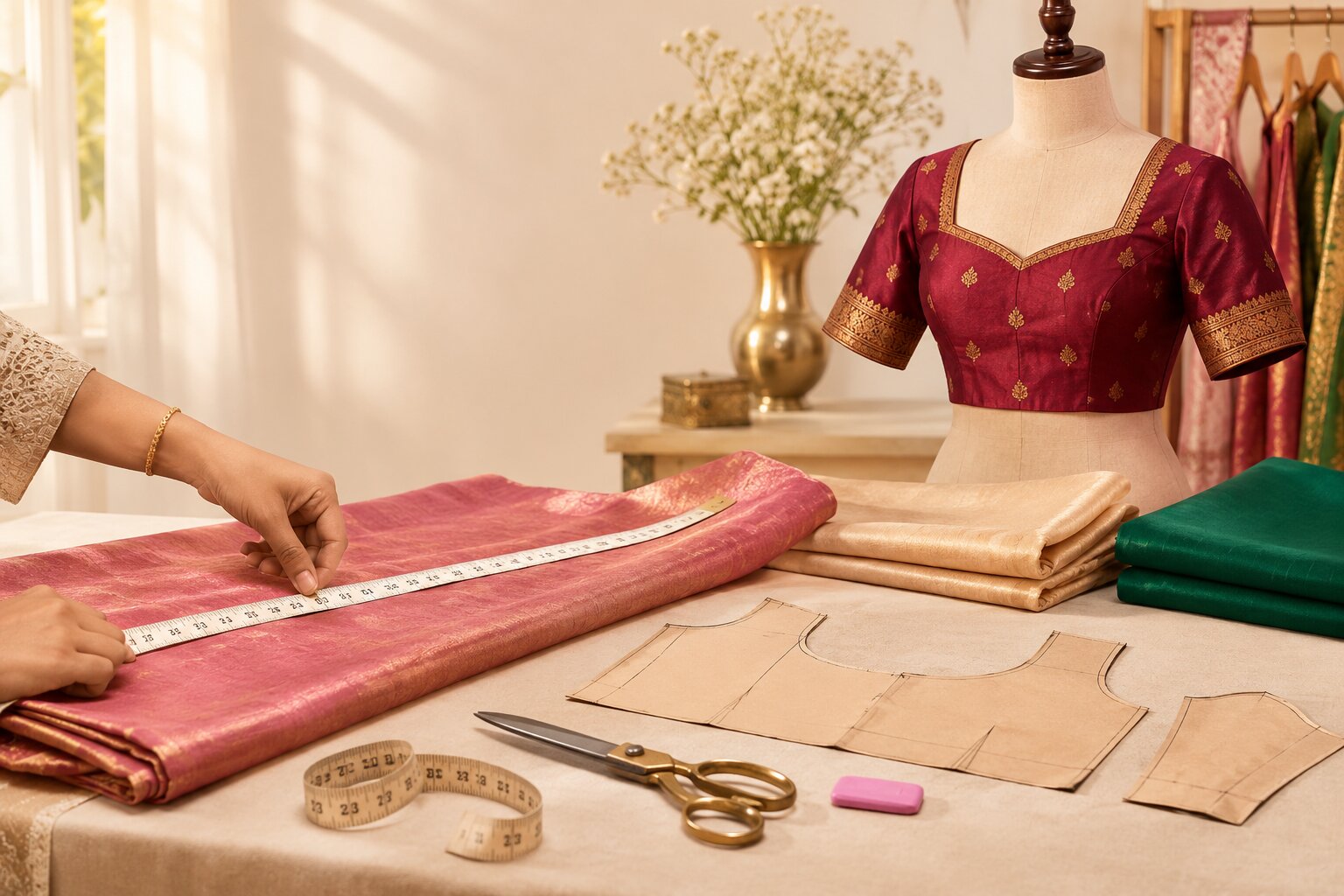
Designer blouses often feature additional seams, panels, decorative details, or unusual silhouettes. As a result, their fabric requirements may be different from those of a basic blouse.
Here is a helpful style-wise guide.
| Blouse design | Approximate fabric required |
|---|---|
| Simple saree blouse | 0.80–1.00 m |
| Princess cut blouse | 1.00–1.30 m |
| Padded designer blouse | 1.00–1.40 m |
| Corset style blouse | 1.25–1.75 m |
| Puff sleeve blouse | 1.15–1.60 m |
| High neck or collar blouse | 1.00–1.50 m |
| Backless or deep back blouse | 0.80–1.20 m |
| Peplum blouse | 1.50–2.50 m |
These broad estimates assume roughly 44-inch-wide outer fabric and typical adult sizes. They are not additive requirements; a short, simple princess-cut blouse can use less fabric than a long, highly structured one.
Princess Cut Blouse
Princess cut blouses use shaped panels to create a fitted silhouette.
The additional seams do not automatically mean you need much more fabric, but the positioning of the curved panels can affect cutting efficiency.
If you’re planning a princess-cut blouse in silk, velvet, or brocade, it is sensible to allow some flexibility for pattern placement.
Padded Designer Blouse
Padded blouses include cups or supportive internal construction.
The padding itself is usually a separate material, so a padded blouse does not always need extra outer fabric. However, structured cups, additional bodice panels, and special finishing can increase fabric use.
Remember to purchase the required lining and cup materials separately.
Corset Blouse
Corset blouses have become a popular choice for modern ethnic styling.
Their fitted silhouettes may include several vertical panels, structured cups, and lace-up backs.
A long corset blouse, in particular, may require more material than a standard waist-length blouse because of its longer bodice and multiple pattern pieces.
Puff Sleeve Blouse
Puff sleeves add beautiful volume around the shoulders and arms.
To achieve that fullness, the sleeve pattern is cut wider than a regular fitted sleeve.
Depending on the size and volume of the puff, your tailor may recommend approximately 0.20–0.40 metres of additional fabric.
Heavy Embroidery and Mirror Work Blouse
A designer blouse featuring sequins, zari, mirror work, beads, or hand embroidery can make even a simple saree look luxurious.
However, embellishment alone does not necessarily increase the basic fabric requirement.
Extra material may be needed when embroidered motifs, floral patterns, borders, or decorative panels must be positioned at specific places on the blouse.
Designer tip: Always check the available embroidery area before cutting expensive handwork fabric. A beautiful motif may be ruined if it falls across a seam or is partially cut away.
6. How Much Lining Fabric Is Needed for a Blouse?
Lining is the fabric stitched inside the blouse to improve its comfort, structure, and finish.
Many blouses made from silk, net, velvet, georgette, and heavily embroidered fabrics benefit from lining.
For a standard blouse, approximately 0.75–1 metre of lining fabric is a common planning allowance. If you want fully lined elbow-length or full sleeves, you may need around 1–1.5 metres, depending on the pattern.
For example, if you are stitching a short-sleeve silk blouse, your fabric shopping list may look like this:
| Material | Approximate quantity |
|---|---|
| Main silk fabric | 1 metre |
| Cotton lining | 0.80–1 metre |
| Piping or decorative finishing | As required |
| Blouse cups, hooks, dori | As required |
Do not assume that the outer fabric measurement already includes lining. Check whether your tailor needs a separate lining piece.
7. Is 0.80 Metre of Saree Blouse Fabric Enough?
Many sarees are sold with an attached, unstitched blouse piece measuring approximately 0.80 metres.
But is that sufficient?
In many cases, yes. A regular 0.80-metre blouse piece may be enough for a simple sleeveless or short-sleeve blouse in a smaller or medium size.
However, it may not be sufficient when you want full sleeves, a larger blouse size, a high-neck design, an extended bodice, or sleeves with elaborate decorative patterns.
If your saree blouse piece is too short, consider using matching or contrasting fabric for the sleeves, decorative panels, or back.
For example, a Banarasi saree with a matching maroon blouse piece can look equally beautiful with contrasting gold tissue sleeves.
8. How to Measure Fabric for a Blouse Before Stitching
Accurate measurements make it easier to estimate fabric requirements and achieve a comfortable fit.
Before purchasing material, make sure you know the following measurements.
| Measurement | How to measure |
|---|---|
| Bust | Around the fullest part of your bust |
| Underbust | Around the ribcage directly below the bust |
| Waist | Around the area where the blouse will end |
| Shoulder | Across the back from shoulder point to shoulder point |
| Blouse length | From the shoulder to the desired blouse hem |
| Sleeve length | From the shoulder point to the sleeve end |
| Sleeve round | Around the arm where the sleeve will fit |
| Armhole | Around the shoulder and underarm |
| Neck depth | From the neckline reference point to your desired depth |
You should take the measurements while wearing the innerwear you plan to use with the blouse. Keep the measuring tape comfortably fitted rather than pulling it too tightly.
An Easy Traditional Fabric Calculation
The CBSE and National Institute of Fashion Technology’s Basic Pattern Development handbook provides a traditional saree blouse fabric estimation method for 90 cm wide fabric:
Fabric length = blouse length + sleeve length + 5 inches
For example, suppose your blouse length is 14.5 inches and your sleeve length is 10 inches.
Example calculation
Approximately 0.75 Metre
Traditional estimate for a particular basic blouse pattern on 90 cm wide fabric, not a universal requirement.
This traditional method is useful for understanding how blouse and sleeve lengths contribute to fabric consumption. However, actual cutting also depends on bust size, pattern-piece width, seam allowances, and design details.
For a reliable estimate, ask your tailor to place the paper pattern pieces on the chosen fabric width before cutting.
9. Common Mistakes to Avoid When Buying Blouse Fabric
Even experienced shoppers sometimes purchase the wrong quantity of fabric for a blouse.
Here are five important mistakes to avoid:
- Ignoring fabric width: One metre of 36-inch-wide fabric is not equivalent to one metre of 60-inch-wide fabric for pattern cutting.
- Forgetting the sleeves: Always choose your sleeve length before estimating the material.
- Not planning for embroidery placement: Borders, stripes, and one-way patterns may require extra fabric to align correctly.
- Forgetting lining and alterations: Account for lining, seam allowances, and the fit adjustments your tailor recommends.
- Ignoring fabric shrinkage: Some washable fabrics should be pre-shrunk before stitching. Follow their care instructions and allow for possible shrinkage.
These precautions can help prevent fabric shortages, unwanted seams, and changes to your original design.
10. How to Choose the Right Fabric for a Designer Blouse
Apart from quantity, fabric selection also determines how your blouse looks and feels.
Cotton fabric is a comfortable option for regular wear and warmer weather. It is particularly suitable for simple and breathable blouse designs.
Silk and Banarasi fabric are beautiful choices for festive outfits and weddings. Their structure and finish complement traditional sarees, but special care may be needed when positioning woven motifs and borders.
Georgette and chiffon can create soft, elegant blouse designs. Depending on the fabric’s transparency and construction, lining or additional support may be necessary.
Velvet fabric gives blouses a luxurious, rich appearance. Since velvet has a directional surface, the cutting layout should keep the nap consistent, which can increase fabric consumption.
Net fabric is popular for stylish sleeves, necklines, and contemporary designer blouse patterns. It is frequently combined with an appropriate lining or opaque bodice fabric.
If you are unsure which material suits your design, discuss the intended neckline, sleeve style, fit, and occasion with your tailor before purchasing.
Conclusion
Understanding how much fabric is needed for a blouse can save you time, money, and unnecessary stitching complications.
For a regular blouse, around 0.80–1 metre is often sufficient, while elbow-length and full-sleeve blouses generally need more. Designer styles, larger sizes, and complicated embroidery placement may also require additional material.
Always consider your blouse size, sleeve length, fabric width, and stitching pattern before making your purchase.
And if you love beautiful designer blouses but would rather skip fabric shopping and stitching, discover the collection of ready-to-wear designer blouses at Designerblouse.co.
From elegant everyday styles to festive embroidered designs, choosing a readymade blouse can make styling your favorite saree simpler and more convenient.
FAQs
How Much Fabric is Needed for a Blouse?
For most standard saree blouses, approximately 0.80–1 metre of 44-inch-wide fabric is sufficient for short sleeves. Long sleeves, larger sizes, and designer patterns may need more.
Is 1 Metre of Fabric Enough for a Blouse?
Yes, 1 metre is usually enough for many regular sleeveless and short-sleeve blouses. It may not be sufficient for larger sizes, long sleeves, or extended blouse designs.
How Much Fabric is Required for a Size 38 Blouse?
A size 38 blouse may require approximately 0.90–1 metre for short sleeves, 1–1.2 metres for elbow sleeves, and 1.3–1.5 metres for full sleeves using 44-inch-wide fabric.
How Much Fabric is Required for a Size 42 Blouse?
A size 42 blouse may need approximately 1–1.2 metres for short sleeves, 1.2–1.4 metres for elbow sleeves, and 1.5–1.7 metres for full sleeves.
How Many Metres of Fabric are Needed for a Full Sleeve Blouse?
For an average adult blouse, 1.25–1.5 metres of 44-inch-wide fabric is a common estimate. Larger sizes or decorative sleeves may need 1.5–1.8 metres or more.
How Much Fabric is Needed for a Sleeveless Blouse?
Approximately 0.70–0.90 metres of 44-inch-wide fabric may be sufficient for a regular sleeveless blouse, depending on size and design.
Is 80 cm of Blouse Fabric Enough?
An 80 cm blouse piece can be sufficient for smaller or medium-sized blouses with simple designs and short sleeves. A full-sleeve or structured designer blouse may require additional fabric.
Does a Padded Blouse Require Extra Fabric?
Not necessarily. Padding is generally a separate material. However, structured cups, elaborate stitching, and additional pattern panels can change the amount of outer fabric needed.
How Much Lining Fabric is Required for a Blouse?
A regular blouse often needs approximately 0.75–1 metre of lining fabric. A fully lined long-sleeve design may require more.
How Much extra Fabric Should I Buy for a Designer Blouse?
Depending on the design, an additional 0.20–0.40 metres may be useful for puff sleeves, motif matching, or special finishing. However, the safest approach is to confirm the exact amount with your tailor.
Shop By Work
Diamond Work Blouse | Hand Work Blouse | Sequin Work Blouse
Shop By Fabrics
Georgette Blouse | Velvet Blouse | Silk Blouses | Net Blouses
Shop By Category
Embroidery Blouses | Bridal Blouse | Readymade Saree Blouse |
Shop By Color
Red Blouse | Black Blouse | Green Blouse | Yellow Blouse | Gold Blouse | Rani Blouse | Maroon Blouse | White Blouse
Shop By Style
Sleeveless Blouse | Apple Cut Blouse | Full Sleeve Blouses | Spaghetti Blouse | Half Sleeve Blouse | Deep Neck Blouse | Halter Neck Blouse
